
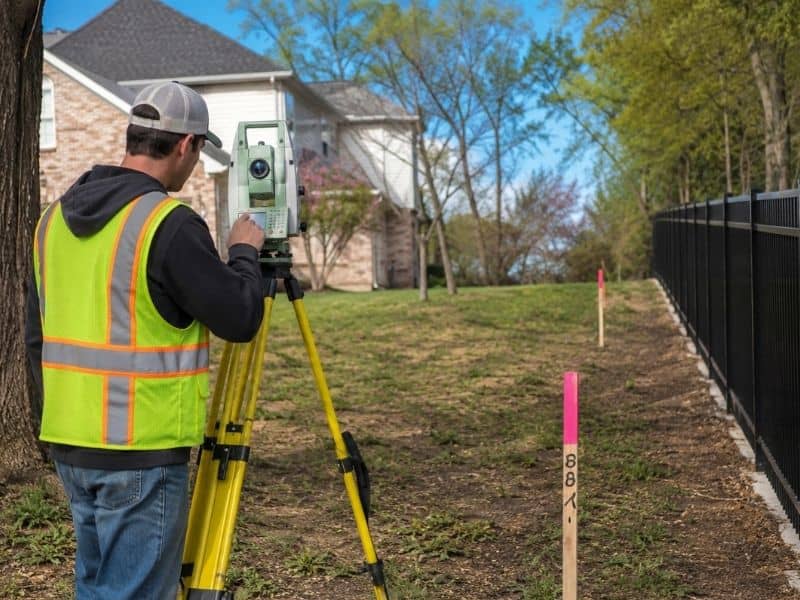
A boundary survey is a professional measurement that legally defines where your property begins and ends. A licensed surveyor finds and marks the exact corners of your land using old deed records, county maps, and physical evidence on the ground. The result is a legal document you can use for permits, real estate deals, and disputes.
What the Surveyor Actually Does
Most people picture someone walking around with a measuring tape. The real process is much more involved.
Before setting foot on your property, the surveyor spends time at the county courthouse reviewing old deeds, prior surveys, and title records. On site, they locate any existing markers, use GPS equipment for precision, and drive new iron rods into the ground at your corner points. Everything gets recorded on a legal map that is filed with the county.
It is worth knowing how a boundary survey differs from other types:
| Survey Type | What It Does |
| Boundary Survey | Marks the legal edges of your property |
| ALTA Survey | Combines boundary data with title details, mainly for commercial deals |
| Topographic Survey | Maps slopes and terrain features for construction planning |
| Construction Staking | Guides where to physically place a building or structure |
When You Actually Need One
Many homeowners point to a fence or tree line and assume that is their property line. Those informal markers carry no legal weight. Here are the situations where a proper survey matters most:
You are buying raw or rural land. Developed subdivisions usually have clear lot lines already recorded. Vacant land rarely does.
You are building near the edge of your lot. A fence, driveway, or home addition that crosses onto a neighbor’s land, even by a foot, can become a costly legal problem.
A neighbor dispute has come up. A licensed survey is the only document that carries real legal weight when lines are in question.
You are settling an estate. Older deeds often use vague language like “to the old oak tree” or “along the creek.” That language needs to be translated into precise measurements before property changes hands.
You are applying for a building permit. Many local governments require confirmed property line information before approving construction.
If you are buying a home in a recorded subdivision with title insurance already in place, your lender may not require a new survey. Even so, title insurance covers ownership problems, not boundary errors. A survey is still worth having.
What It Costs and Why It Is Worth It
Most residential boundary surveys run between $500 and $1,500. Complex or large properties can cost more. The main factors are lot size, terrain, how recently the land was last surveyed, and how complicated the deed history is.
That upfront cost looks small next to the alternative. A boundary dispute that ends up in court typically costs over $10,000, and that is before any required demolition or relocation of a misplaced structure.
The Risks of Skipping One
You could be forced to tear something down. If a structure you built crosses a property line, a court can order you to remove it at your expense.
A future sale could fall apart. Boundary problems almost always show up during a title search. Fixing them under deadline pressure at closing is expensive and stressful.
You could lose land without knowing it. In some states, if a neighbor has been openly using a strip of your land for years, they can make a legal claim to it. Clear markers help prevent that.
The National Society of Professional Surveyors reports that boundary disputes are among the most common reasons for real estate lawsuits in the country. A single early survey prevents most of them.
FAQ
How long does it take?
One to three weeks for most residential properties, depending on research time and the surveyor’s schedule.
Who can legally do it?
Only a licensed Professional Land Surveyor (PLS). Each state sets its own licensing requirements.
Can I use Google Maps instead?
No. Online parcel maps are estimates based on digitized old records. They are not legally binding and will not hold up in a permit application or dispute.
