
Your lender says you need flood insurance. The premium hits your account. Your house sits on a hill that hasn’t seen standing water in decades. There’s a legal process that can fix this, and it starts with two documents most homeowners have never heard of: an elevation certificate and a LOMA.
FEMA flood maps cover the entire country, but they’re drawn at a scale broad enough that individual homes often get misclassified. The maps take three to five years to update, and during that window, properties that sit safely above flood levels still get assigned mandatory insurance requirements.
An elevation certificate, completed by a licensed land surveyor, gives FEMA the property-specific data needed to correct that error officially.
What Is an Elevation Certificate?
An elevation certificate is an official FEMA document that records the precise elevation of your home’s lowest floor relative to the Base Flood Elevation (BFE) for your area.
The BFE is the flood height FEMA projects for a “100-year flood,” which is a flood event that carries a 1% chance of occurring in any given year. If your home’s lowest point sits at or above the BFE, you may not legally belong in the flood zone your lender is treating you as if you do.
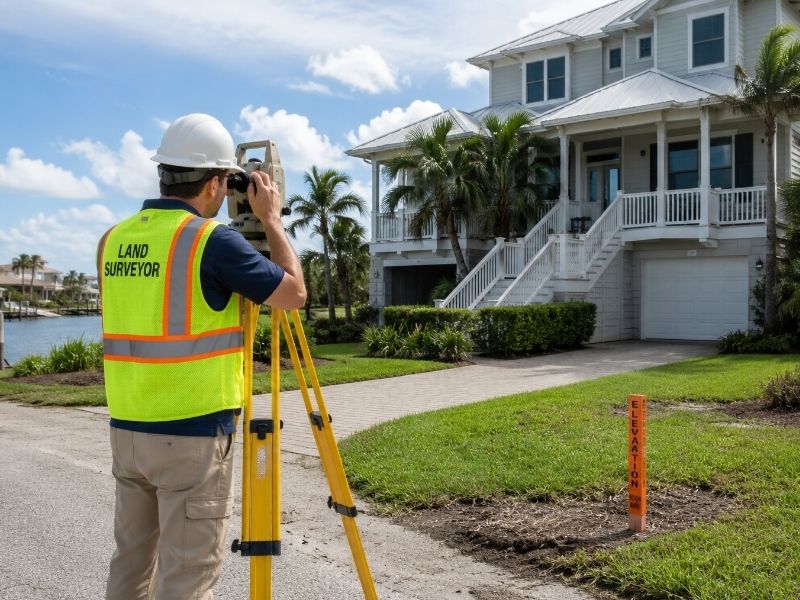
Only a licensed land surveyor, engineer, or architect authorized by law can complete an elevation certificate. The surveyor visits the property, takes precise measurements of the structure and surrounding ground. That completed form is the document everything else in this process depends on.
The cost runs between $150 and $800 in most parts of the country, varying by location and property complexity. Measured against years of flood insurance premiums, most homeowners find that cost recoverable within the first policy year alone.
What the Surveyor Actually Measures
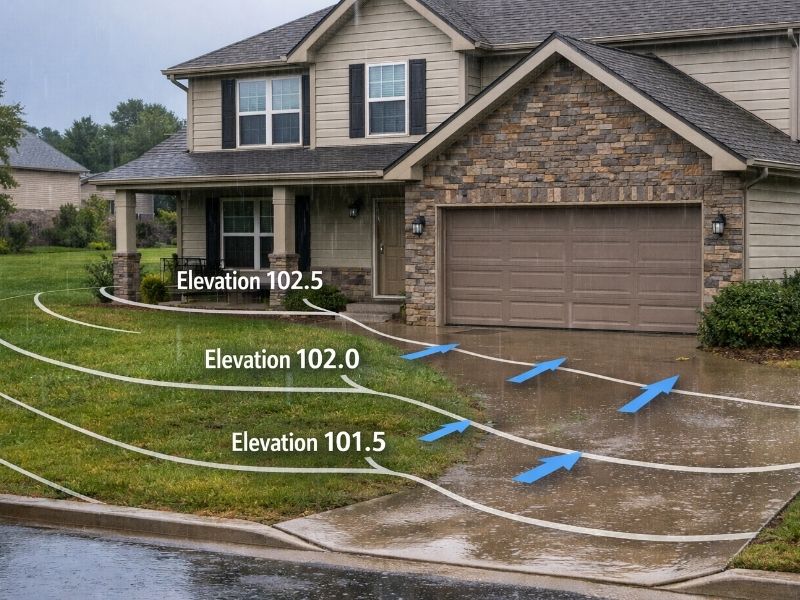
Two numbers drive the LOMA eligibility decision. The first is the Lowest Adjacent Grade (LAG), which is the lowest elevation of the ground touching your home’s foundation. The second is the Base Flood Elevation (BFE) from FEMA’s Flood Insurance Rate Map (FIRM) for your specific address. If the LAG meets or exceeds the BFE on naturally high ground, not fill, the property qualifies for a LOMA application.
What Is a LOMA and How Does It Remove the Flood Insurance Requirement?
A LOMA, or Letter of Map Amendment, is an official determination from FEMA stating that a specific property or structure was incorrectly included in a Special Flood Hazard Area (SFHA). Once FEMA issues a LOMA, federal law no longer requires your lender to mandate flood insurance on your loan. The legal obligation disappears.
FEMA created the LOMA process because flood zone boundaries drawn at a mapping scale cannot account for the precise ground elevation of every structure inside them. A property can sit entirely within a shaded flood zone on the FIRM and still have a lowest floor that’s physically higher than the base flood level. The LOMA is how FEMA corrects that discrepancy on a property-by-property basis.
The approval timeline depends on how you apply. Licensed surveyors and engineers with access to the eLOMA portal can submit directly and often receive a determination within minutes. Homeowners and other applicants using the Online LOMC tool typically wait up to 60 days. Either way, FEMA reviews the elevation data, checks it against the firm, and issues a formal determination letter.
How to Read Your Elevation Certificate Results
When the surveyor returns the completed elevation certificate, the key comparison is simple: LAG versus BFE. If the LAG is at or above the BFE on ground that hasn’t been artificially raised with fill, the property is eligible for a standard LOMA. If the LAG is below the BFE, a LOMA isn’t available, but the elevation certificate still has value. Insurance agents can submit the more accurate elevation data under FEMA’s current pricing system, Risk Rating 2.0, and many homeowners see a lower premium even without a full flood zone removal.
Risk Rating 2.0, which FEMA fully rolled out in April 2023, calculates premiums based on more than 30 property-specific data points, including the exact elevation of your lowest floor relative to BFE. Before that system, flood zone designation alone drove most of the premium. Now, even homeowners who stay inside the SFHA can benefit from an elevation certificate that shows their structure sits higher than the map assumed.
How to Submit the LOMA Application to FEMA
The LOMA application goes to FEMA through one of two tools. The eLOMA portal is the faster option and is reserved for licensed surveyors and engineers registered with the system. Determinations through eLOMA often come back the same day. The Online LOMC tool accepts applications from anyone and carries a standard review window of up to 60 days.
To complete the application, you’ll need the signed elevation certificate, the property’s legal description and address, the FIRM panel number and effective date for your area, and the property owner’s name and contact information. Your surveyor can submit on your behalf through either tool, which removes the risk of errors that could delay the determination.
FEMA will issue one of two outcomes. An approved LOMA means your property or structure is officially removed from the SFHA. A denial means the elevation data didn’t clear the BFE threshold, and the existing flood zone designation holds.
What to Do After FEMA Approves the LOMA
Send the LOMA determination letter to your mortgage lender in writing and ask them to remove the mandatory flood insurance requirement from your loan. Federal law ties that requirement to SFHA designation. Once a LOMA removes the designation, the legal basis for the requirement is gone.
Some lenders process the removal within days. Others take up to a month. If you don’t receive written confirmation within 30 days, follow up directly with your loan servicer’s insurance compliance department. After the lender confirms the requirement is lifted, contact your flood insurance provider and request a pro-rated refund on the remaining policy period.
Homeowners who complete this process successfully save between $500 and $2,000 per year on average, depending on their prior premium level and flood zone. Over a 30-year mortgage, the total savings can run into five figures.
When Lenders Still Push Back
Some lenders accept a LOMA that removes the structure but still require that the entire land parcel be removed from the SFHA before they’ll drop the insurance mandate. If that happens, ask your lender in writing what their specific removal criteria are. If they require full parcel removal, your surveyor may need to pursue a LOMR-F, which is a Letter of Map Revision Based on Fill. That process applies when land was elevated using fill material rather than natural topography, and it carries its own application requirements and review timeline.
Why Getting an Elevation Certificate Is Worth It Right Now
FEMA’s flood insurance program, the National Flood Insurance Program (NFIP), is authorized only through September 30, 2026. Congress has extended it 35 times since 2017 through short-term measures, and each lapse freezes new policy issuance and can delay home closings nationwide. Homeowners who act before the deadline have access to the full LOMA process without the uncertainty a lapse creates.
At the same time, Risk Rating 2.0 means your elevation data now has a direct and measurable effect on your premium, separate from any flood zone removal. A single elevation certificate from a licensed land surveyor creates the documentation record that supports a LOMA application, an insurance rate appeal, and any future map amendment challenge. Without it, none of those options are available. If your home sits on high ground and you’ve been paying for coverage you may not need, the elevation certificate is where the case for removal starts.
